
Since COVID-19, eviction filings have risen dramatically each year in both Mecklenburg County and North Carolina. However, over the past year, filings have declined sharply across the state, with Mecklenburg County experiencing an especially significant decrease. This analysis examines the eviction process in North Carolina, explores the data behind these trends, and considers the factors that may be contributing to the recent decline.
Every day, street outreach staff members meet people experiencing unsheltered homelessness where they are: in parks, on sidewalks, in encampments, and under bridges. They build trust, assess needs, and connect people experiencing homelessness to critical resources and shelter. This work is often the first step for the people they serve towards stability. Street outreach teams also play a key role in the annual Point-in-Time (PIT) Count by helping to ensure people experiencing homelessness are counted and connected to services. While their work happens out in the community, it is not always visible to the public.
To get a better understanding of what their work is like, we asked one street outreach team member a series of questions about their role. Their answers below provide an overview of their daily obligations, challenges, and small victories that go into their work.
On Wednesday, January 27, 2027, the Charlotte-Mecklenburg community will come together to for the 2027 Point-in-Time Count. This annual event is more than counting the number of people experiencing homelessness. It is an opportunity to recognize our neighbors, strengthen community connections, and support efforts to create lasting solutions for some of Charlotte-Mecklenburg’s most vulnerable residents.
This post explains why the PIT Count matters and how you can get involved in making sure everybody counts.
If you have ever wanted to know how someone who is currently experiencing homelessness or is at very imminent risk of homelessness accesses available resources in Mecklenburg County (as well as in most other communities in the US), the answer is through completing a coordinated entry (CE) assessment. This blog gives an overview of what CE is and how it operates.
Since its inception in 2019 , the “One Number” has served as the primary benchmark for the number of people experiencing homelessness in Charlotte-Mecklenburg. It provides the best available snapshot of people actively experiencing homelessness and offers critical insight into the minimum number of housing units and subsidies needed today to address that need. The One Number also tracks how people flow into and out of the homeless services system over time.
This week’s blog provides the most recent One Number update, key trends and analysis, and what the latest data mean for Charlotte-Mecklenburg.
Every day coordinated entry staff members are the front line of the homelessness response system. They complete assessments, answer phones, and help connect people to available resources, for which the need far exceeds the availability. While their work is not often visible, it shapes who gets help and when.
To get a better picture of what this work is actually like, we asked one coordinated entry staff member a series of questions about their role. Their answers provide an overview of their daily obligations, challenges, and small victories that go into their work.
This weekend, October 10–11, 2026, the National Faith Coalition to End Homelessness (NFCEH) is leading a “Weekend to End Homelessness” across the country. This event intentionally coincides with World Homeless Day, which is October 10th. For this event, over 500 churches throughout the US intend to dedicate their services, prayers, bible classes, and educational curricula to spread awareness about homelessness, what local housing providers are doing, and what practices have been shown to work to mitigate homelessness. This post discusses this event as well as what faith-based organizations have been doing in recent years in the Charlotte area.
The 2025 Budget Reconciliation Law, also known as H.R. 1, makes significant changes to Medicaid and the Supplemental Nutrition Assistance Program (SNAP), more commonly known as food stamps. While the changes for SNAP have already gone into effect, the changes to Medicaid begin October 1, 2026, for non-citizen residents. The new work requirements for those who are enrolled in Medicaid Expansion, among other changes, will go into effect on January 1, 2027. This post reviews these changes to Medicaid and SNAP, how they impact housing insecurity and homelessness, as well as what residents who receive these benefits should do.
Since its inception in 2019 , the “One Number” has served as the primary benchmark for the number of people experiencing homelessness in Charlotte-Mecklenburg. It provides the best available snapshot of people actively experiencing homelessness and offers critical insight into the minimum number of housing units and subsidies needed today to address that need. The One Number also tracks how people flow into and out of the homeless services system over time.
CAYCE JAMIL, Ph.D.
Senior Management Analyst – Homelessness and Housing Research Coordinator
Mecklenburg County Community Support Services
On July 23, 2026, the National Low Income Housing Coalition (NLIHC) released their latest Out of Reach 2026: The High Cost of Housing report. This annual report highlights the mismatch that exists between individuals’ wages and housing prices nationally, at the state level, and in every metropolitan area in the country.
The report revolves around their central statistic, the Housing Wage, which estimates how much it would cost a full-time wage earner to rent a home at the US Department of Housing and Urban Development’s (HUD) Fair Market Rate (FMR) without spending more than 30% of their income on rent and utilities combined.
Key Takeaways
Comparing Housing Wages Nationally and Regionally
Overall, the report shows that the average renter in the US is unable to afford a 1-bedroom unit without being cost-burdened. A household is considered cost-burdened when they spend more than 30% of their income on their rent or mortgage, combined with utilities.
As shown in the table below, at the national level, a single full-time wage earner needs to earn $29.19 per hour to afford a one-bedroom rental unit at their Housing Wage, and $34.73 per hour to afford a two-bedroom rental unit at their Housing Wage. This is similar to the rates in the Charlotte-Concord-Gastonia Area, which are slightly higher for a one-bedroom and slightly lower for a two-bedroom (see table 1 below).
Table 1: Comparing Housing Wages Nationally, in North Carolina, and in Charlotte Metropolitan Area
National |
North Carolina |
Charlotte Metropolitan Area |
|
1-Bedroom Housing Wage |
$29.19 |
$23.93 |
$29.58 |
2-Bedroom Housing Wage |
$34.73 |
$27.11 |
$32.42 |
Changes in Fair Market Rents for the Charlotte Metropolitan Area
Notably, these rates are slightly lower for the Charlotte Metropolitan Area compared to last year, which was $31.67 for a 1-bedroom housing wage, and $35.08 for a 2-bedroom housing wage. This occurred because the FMR for the Charlotte Metropolitan Area was set lower than the previous year. The FMR is set based on recent movers in the 40th percentile of gross rentals in the American Community Survey, which was estimated to be slightly lower than the previous year. Therefore, the FMR for a 1-bedroom unit in the Charlotte Metropolitan Area is now $1,538 per month (down from $1,647 per month in 2025) and for a 2-bedroom is now $1,686 per month (down from $1,824 per month in 2025).
Table 2: Fair Market Rent Rates for the Charlotte Metropolitan Area by Fiscal Year
Year |
Efficiency |
1 Bedroom |
2 Bedroom |
3 Bedroom |
4 Bedroom |
FY 2024 |
$1,347 |
$1,384 |
$1,554 |
$1,936 |
$2,481 |
FY 2025 |
$1,586 |
$1,647 |
$1,824 |
$2,250 |
$2,852 |
FY 2026 |
$1,469 |
$1,538 |
$1,686 |
$2,076 |
$2,637 |
National Wage Gaps and Affordability Challenges
At the national level, these numbers are concerning as the average hourly wage of renters nationally is $24.84, which is $4.35 per hour less than what is needed to afford a one-bedroom and $9.89 per hour less than what is needed to afford a two-bedroom at their Housing Wage. Roughly 60% of all full-time wage earners nationally cannot afford to rent a one-bedroom unit at the Housing Wage.
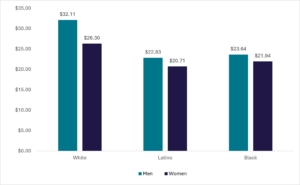
Moreover, as shown in the figure below, at the national level, there are significant disparities in hourly wage related to race, ethnicity, and gender. While the median wage of full-time White male workers ($32.11) is enough to afford the one-bedroom housing wage, all other demographics in the report fall short of this threshold.
Figure 1: National Median Wages by Race and Gender
Regional Snapshot: Mecklenburg County and the Charlotte Metro Area
Summarizing the data for the region, in Mecklenburg County 44% of the 466,527 households were identified as renters, and in the Charlotte Metropolitan region, of which Mecklenburg County is one portion of, 38% of the 728,586 households were identified as renters. Compared to the national level, the region paints a slightly more optimistic picture. In Mecklenburg County the average hourly wage of renters is $32.23 (roughly $67,050 a year), which can cover a 1-bedroom housing wage in the area, and almost a 2-bedroom housing wage. In the Charlotte Metropolitan Area, the average hourly wage of renters is $29.18 (roughly $60,695 a year), which is just below a 1-bedroom housing wage. The average wage of renters has also increased since last year, which was $30.97 (roughly $64,500 a year) in Mecklenburg County, and $27.81 (roughly $57,850 a year) in the Charlotte Metropolitan Area.
The annual median income (AMI) of households for the Charlotte Metropolitan Area, which includes both homeowners and renters, is $117,400. In comparison, the median renter household income is $65,834, which is very close to the mean AMI of renters (roughly $67,050), and can afford a one-bedroom at the Housing Wage.
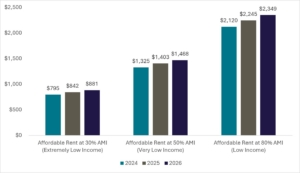
Next, focusing on the AMI of households, 80% of this figure is considered by the HUD to be low income, 50% is considered very low, and 30% is considered to be extremely low income. Low income in the Charlotte Metropolitan Area, which is 80% of the AMI, is $93,920 a year. This salary can afford a one- or two-bedroom unit at FMR and could even afford a three-bedroom unit at FMR, which is $2,076 per month. However, a very low income, which is 50% of the AMI, is $58,700 and cannot afford a one-bedroom at the Housing Wage. Similarly, 30% of the AMI, which is considered an extremely low-income for an area, is $35,220, and also cannot afford a one-bedroom at the Housing Wage. The chart below shows affordable rents for each of these household incomes over the last three years.
Figure 2: Affordable Rent in Charlotte Metropolitan Area by Income
The report also highlights the minimum wage. North Carolina is one of twenty states that still rely on the federal minimum wage of $7.25 per hour. For someone working a minimum wage job to afford a one-bedroom unit at FMR in the Charlotte Metropolitan Area, they would need to work 156 hours a week. As a reminder, a week is comprised of 168 hours. In other words, an individual would need to work just over 4 full-time jobs at minimum wage to afford a one-bedroom unit at FMR. Notably though, Mecklenburg County Government, the City of Charlotte Government and the Charlotte-Mecklenburg School District all pay employees above the Federal minimum wage. The minimum wages for each are $25.53 per hour, $25 per hour, and $20 per hour, respectively.
Conclusion
The Out of Reach 2026 report shows that, across the nation, the average renter is cost-burdened by housing. In the Charlotte Metropolitan Area, primarily due to a lower Fair Market Rent metric this year set by the HUD, renters appear to be slightly less cost-burdened compared to the rest of the nation. Indeed, with a dip in rental rates and an increase in wages, renters in the Charlotte Metropolitan Area appear to be doing better in comparison to the previous year.
However, with that said, the HUD has already released the FMR rates for FY 2027, and for the Charlotte Metropolitan Area, they increase from FY 2026 to rates very similar to FY 2025. Therefore, although this year’s Out of Reach appears optimistic due to the drop in FMRs, this is likely an anomaly rather than a new norm. The number of households that are cost-burdened has increased across the nation, and, except for this fiscal year, the Charlotte Metropolitan Area has followed this trend. As a reminder, cost-burdened households face higher risks of eviction, displacement, and homelessness. Continued investments, like through the Charlotte Housing Trust and Ascent Housing, are crucially needed to mitigate these tendencies in the region.