

Mary Ann Priester, PhD, MSW
Senior Management Analyst
Mecklenburg County Community Support Services
Housing instability, homelessness, and stable housing are often discussed as separate issues. In reality, they are interconnected stages along a single housing continuum that reflects whether households are able to obtain and maintain safe, affordable, and sustainable housing over time. The newly released Charlotte-Mecklenburg State of Housing Instability and Homelessness (SOHIH) Report examines this continuum by analyzing conditions at three critical points: housing instability, homelessness, and stable housing. Together, these stages illustrate both how households lose housing and what is required to restore and sustain housing stability.
This blog is the first in a five-part series that takes a deeper look at findings from the 2025 SOHIH Report. Each post in this series examines a different stage of the housing continuum and explores what the data reveal about housing stability, homelessness, and access to stable housing in Charlotte-Mecklenburg. Together, this series provides a deeper understanding of how housing challenges develop and what is required to improve housing stability across our community.
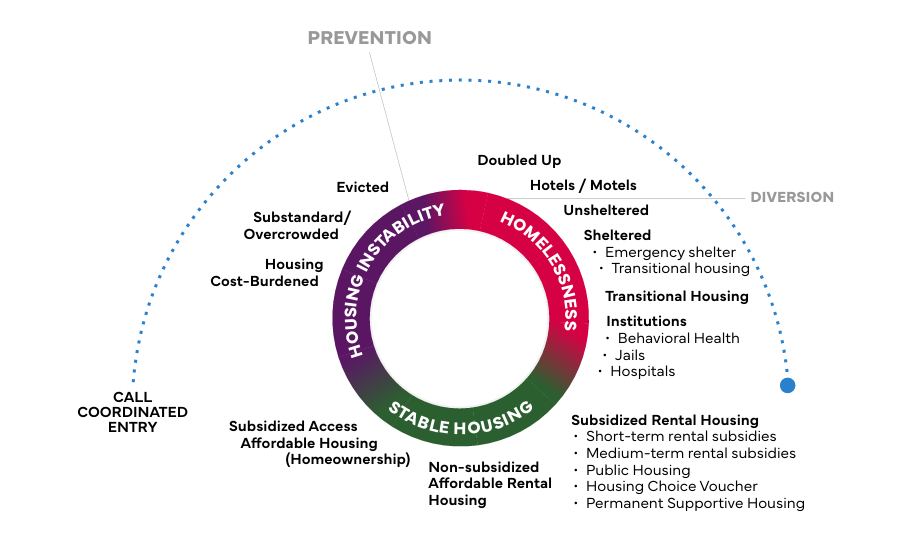
HOUSING INSTABILITY: THE EARLIEST STAGE OF HOUSING LOSS
Housing instability affects the largest number of households and represents the earliest stage of housing loss. Households experiencing instability may struggle to afford rent, face eviction, or live in housing that is overcrowded or otherwise unsustainable.
Housing instability is often driven by structural factors such as rising housing costs, limited affordable housing supply, and income constraints. Without intervention, housing instability can escalate into homelessness. Understanding housing instability is critical because preventing housing loss is often more effective and less costly than resolving homelessness after it occurs.
HOMELESSNESS: WHEN HOUSING INSTABILITY BECOMES HOUSING LOSS
Homelessness represents the most severe form of housing instability. Households experiencing homelessness have lost access to safe and stable housing and often rely on emergency shelters, transitional housing, or unsheltered living situations.
Homelessness reflects both inflow into homelessness and barriers to exiting homelessness. When affordable housing is unavailable, households remain homeless longer, and system capacity becomes constrained. Reducing homelessness requires both preventing housing loss and ensuring that households experiencing homelessness can access permanent housing.
STABLE HOUSING: THE FOUNDATION FOR LONG-TERM STABILITY
Stable housing represents the endpoint of the housing continuum. Stable housing is permanent, affordable, and sustainable over time. Stable housing not only resolves homelessness but also prevents future housing instability. Long-term rental assistance and deeply affordable housing play a critical role in ensuring that households can maintain housing stability. Without sufficient access to stable housing, households remain vulnerable to repeated cycles of housing instability and homelessness.
WHY THE HOUSING CONTINUUM MATTERS
Understanding the housing continuum helps clarify how housing challenges develop and what solutions are required at each stage. Housing instability increases the risk of homelessness. Homelessness reflects gaps in access to affordable housing and housing stability resources. Stable housing provides the solution that allows households to exit homelessness and remain housed. Addressing housing challenges effectively requires coordinated investments across the entire continuum, including prevention, emergency response, and permanent housing solutions. In Charlotte-Mecklenburg, over 108,000 renter households are cost-burdened, and more than 2,600 individuals are currently experiencing homelessness. These data illustrate how housing instability and homelessness are interconnected and reinforce the importance of strengthening housing stability across the entire housing continuum.
Stay tuned for future blog posts, which will take a deeper dive into each aspect of the housing continuum.
SIGN UP FOR BUILDING BRIDGES BLOG