
Cayce Jamil, Ph.D.
Senior Management Analyst
Division of Housing Innovation and Stabilization Services
Mecklenburg County Community Support Services
Changes in Medicaid and Food Assistance
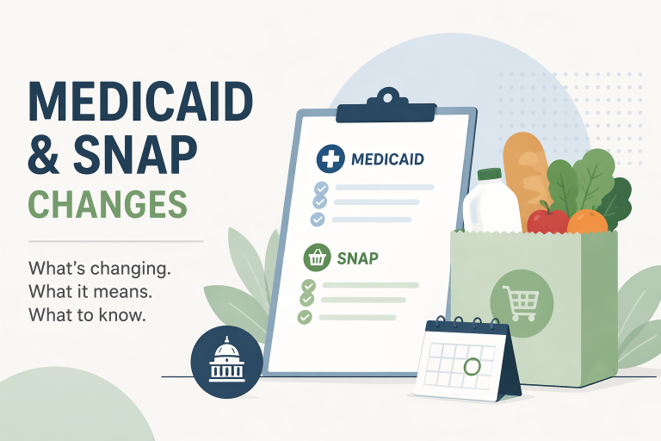
The 2025 Budget Reconciliation Law, also known as H.R. 1, makes significant changes to Medicaid and the Supplemental Nutrition Assistance Program (SNAP), more commonly known as food stamps.
Starting October 1st, 2026, many non-citizen immigrants that are lawfully living the US will lose Medicaid coverage, including refugees, asylees, and trafficking victims who do not have a green card. Immigrants who were not lawfully living in the US were not previously eligible for Medicaid. To qualify for Medicaid now, non-citizens will need to have been a green card holder for at least 5 years, have Cuban Haitian entrant status, or be a “COFA” migrant (citizen of Palau, Marshall Islands, or Micronesia). There are exceptions though for being pregnant, having a child in the last year, and for children 18 and under. In Mecklenburg County, as of August 2026, there are an estimated 16,990 non-citizens that have coverage through Medicaid. Also, starting January 1, 2027, only these same groups of non-citizen immigrants will be eligible for the Affordable Care Act tax credits and subsidies, but there is not a 5-year waiting period for green card holders.
More significantly, starting January 1, 2027, adults between the ages of 19 and 64 receiving Medicaid through North Carolina’s 2023 expansion are now at risk of losing coverage. In Mecklenburg County, as of August 2026, it is estimated that there were 96,282 residents who had Medicaid through the expansion, which is roughly 8% of county residents. To maintain enrollment in Medicaid, these individuals will now need to provide documentation that they are attending school, working, or engaging in other approved activities like community engagement activities for at least 80 hours a month. Alternatively, these households can prove that they have an income of at least $580 a month. There are exemptions though, like being the caretaker for a child under the age of 14, receiving inpatient institutional services, being in prison or jail or recently released, etc..
Additionally, under H.R.1, those covered by Medicaid Expansion will need to renew their coverage every 6 months, instead of once a year. During these renewals, beneficiaries will need to provide evidence that they have met the work requirements, or the household income requirement, for three of the six months (which does not have to be consecutive months). Additionally, for those enrolling in Medicaid Expansion after January 1, 2027, they will need to provide documentation for three consecutive months that they meet the work or income requirements before they can apply.
For SNAP, many of these changes have already been implemented. Like with Medicaid, many non-citizen groups are no longer eligible, including refugees, asylees, and trafficking victims who do not have a green card. Moreover, while SNAP previously has had work requirements, like what is going into effect for the Medicaid Expansion, these requirements have now been expanded to include adults between the ages of 55 and 65. Exemptions for Veterans, persons experiencing homelessness, and youth who have aged out of foster care have also been eliminated. In Mecklenburg County, there are around 132,000 residents that receive SNAP benefits, which is roughly 10% of county residents.
Many analysts argue that these new policies will lead to much lower rates of coverage, not because of the number of households now being ineligible, but primarily because of the paperwork and reporting requirements involved, especially for Medicaid. Additionally, North Carolina is one of ten states in which Medicaid eligibility determinations are handled at the county level, rather than at the state level. This means implementing this new requirement will likely look different from county to county.
Medicaid Expansion and Housing Insecurity
The work requirement provision in H.R. 1 impacts the 40 states that expanded access to Medicaid. Traditional Medicaid applies to children, parents/caretakers, pregnant women, people with disabilities and seniors. Single adults under 65 without disabilities cannot be covered by traditional Medicaid. Additionally, there are income limits for each of these categories, like parents/caretakers are covered up to 45% of poverty line, while children are covered up to 211% of poverty line.
When the Affordable Care Act rolled out over a decade ago, there were healthcare coverage gaps in these states for many low-income adults. Medicaid Expansion extended coverage to meet these gaps. This coverage included low-income single adults as well as parents that had previously earned too much money to qualify for Medicaid. In December 2023, North Carolina expanded its Medicaid access, thereby closing the healthcare coverage gaps. Single adults under the age of 65 years of age are now covered by Medicaid, provided their income is less than 138% of the federal poverty line, which is roughly $22,000 a year for a single person.
Roughly two-thirds of the unhoused population in the US are single adults, and unless they have a disability, do not qualify for traditional Medicaid. Medicaid Expansion increased coverage for people experiencing homelessness and housing insecurity.
For those who are in housing but are financially burdened, some studies have found that poor health and a lack of healthcare coverage are some primary causes of homelessness. Without adequate health insurance, an emergency room visit or surgery can drain an individual’s financial reserves and lead to homelessness. Once unhoused, this difficult experience tends to create more health issues. In turn, poor health is one of the key reasons that the unhoused have a high number of visits to the emergency room and inpatient use. One of the clear benefits of expanded Medicaid access has been improved access to healthcare services and quality of care. For instance, among persons experiencing homelessness, Medicaid Expansion has been found to be associated with fewer drug overdose deaths, fewer hospital visits, and increased access to prescription drugs.
What Residents who Receive Medicaid Expansion or SNAP Should Do
Mecklenburg County residents who are currently enrolled in Medicaid Expansion or SNAP are encouraged to:
- Ensure that Mecklenburg County has your current phone number and mailing address;
- Get an enhanced ePASS account to upload and share your documents with Mecklenburg County;
- Document work, volunteer, or school hours;
- And read every notice that you receive from the County and respond by the deadlines.
If your Medicaid is terminated or reduced to Family Planning coverage, you have the right to appeal and request continued benefits until the hearing. For more information about the changes to Medicaid and SNAP, visit the Mecklenburg County Department of Community Resources website.