
Cayce Jamil, Ph.D.
Senior Management Analyst
Division of Housing Innovation and Stabilization Services
Mecklenburg County Community Support Services
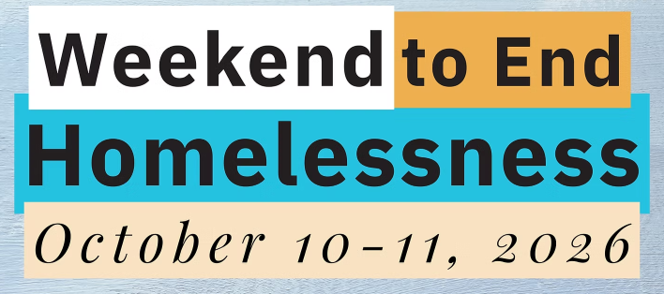
Weekend to End Homelessness
This weekend, October 10–11, 2026, the National Faith Coalition to End Homelessness (NFCEH) is leading a “Weekend to End Homelessness” across the country. This event intentionally coincides with World Homeless Day, which is October 10th.
For this event, over 500 churches throughout the US intend to dedicate their services, prayers, bible classes, and educational curricula to spread awareness about homelessness, what local housing providers are doing, and what practices have been shown to work to mitigate homelessness. NFCEH has put together a 70 page “toolkit” for participating congregations to discuss and educate their members on the topic. From this acknowledgement of the reality of homelessness, the NFCEH intends this event to be a launching pad for further action from faith-based communities to assist in overcoming homelessness.
In Charlotte-Mecklenburg, Caldwell Presbyterian Church, next to Independence Park, has registered to participate in the event. Notably, next door to the Church, Caldwell Presbyterian Church converted one of their buildings in 2025 into Easter’s Home. Easter’s Home houses 21 studio apartments for individuals who have experienced chronic homelessness. Working with Roof Above, they select individuals whose income falls between 30% to 50% of the Area Median Income (AMI) and asks residents to pay no more than 30% of their income towards rent. Once housed, Roof Above provides supportive services for the residents.
Faith-Based Initiatives in the Charlotte Area
Faith-based organizations have a long track record in Charlotte of helping to overcome homelessness and increase affordable housing. One of the longest running examples is Room in the Inn, which expanded to Charlotte in 1996. Coordinated by Roof Above, Roof in the Inn partners with a network of churches and community organizations. The partner sites provide meals, overnight winter shelter, and other services for the needy, particularly during the winter. In recent years, the program operates in around 75 congregations and community sites in the area, down from over 100 before the pandemic.
The Salvation Army, another faith-based organization, has been deeply involved in mitigating homelessness and housing insecurity in the Charlotte area. For example, the Salvation Army has the Center of Hope near Uptown Charlotte for women and children dealing with homelessness. Every night, they sleep an average of 275 people. The Salvation Army also partners with Inlivian to offer 60 apartments for families living at the Center of Hope to move to for 5 years at a time for them to get stabilized.
Driven by these various faith-based projects in the area, in 2024, the City of Charlotte created the Faith in Housing Initiative, which partners with faith-based organizations to increase affordable housing in the area. In the past two years, more than 200 faith-based organizations have participated in their events focused on expanding affording housing and impacting the community. The Initiative also recently held a technical assistance grant competition where at least 25 organizations would receive up to $30,000 to create affordable housing and community serving spaces.
Through this partnership, the city works to transform the underutilized land and buildings of select local faith-based organizations into affordable housing and developments that serve the community. Currently, the city is working with a cohort of 12 faith-based organizations who collectively own over 88 acres of land in Charlotte to turn some of their property into rental housing, senior housing, community-serving spaces, and mixed-use developments.
One of those in this cohort, The Park Church, completed an 80-unit affordable housing project for seniors 55 years and older in 2023. Now, they are working to modify 30 acres next to their church into 320 affordable units. Similarly, Mission City Church in the University area is attempting to rezone roughly 5 acres of land for 65 townhomes for households earning 80 percent or less of the annual median income.
Relatedly, as discussed in a previous Building Bridges post by Mary Ann Priester and Liz Ward, there has been an array of faith-based development projects that have been working with the city to bring more affordable housing to the local area. These projects contribute land, buildings, and capital, as well as provide workforce development skills and jobs for people in the community. These include projects working with the city to offer affordable housing like:
- Centra Square, completed in 2018 through a partnership with St. Paul Baptist Church. They offer 112 apartments for people earning under 60% of the AMI.
- Mezzanine on Freedom, completed in 2020 through a partnership with Covenant Presbyterian Church. They offer 185 apartments for people earning between 30% to 80% of the AMI.
- Guardian Angel Villa, completed in 2021 through a partnership with The Catholic Diocese of Charlotte. They offer 81 units that serve low-income seniors that are 55 years and older.
- Sugaree Place, completed in 2023 through a partnership with Mayfield Memorial Baptist Church. They offer 51 apartments for people earning between 30% to 80% of the AMI.
- Varick on 7th Street, completed in 2024 through a partnership with Little Rock A.M.E. Zion. They have 53 apartments for people earning between 30% to 80% of the AMI, and the other 52 apartments are market-rate.
- Mount Moriah Seniors, set to be completed later this year through a partnership with Mount Moriah Missionary Baptist Church. They plan to offer 92 affordable units to seniors 55 years and older.
Moreover, there are too many faith-based communities to name that provide meals and other services to the homeless and needy in the region. To give just one example, Mecklenburg Metropolitan Interfaith Network mobilizes organizations and individuals of different faiths throughout the county to strengthen the local community. This includes assisting with the Point-in-Time Count to track unsheltered individuals, serving meals at local shelters, and establishing an eviction prevention fund to prevent households from being evicted.
Why Does This Matter?
A nationwide faith-based event focused on homelessness has the capacity to increase initiatives from faith-based communities that focus on mitigating homelessness and housing insecurity. In the Charlotte area, these communities are already providing a wide range of innovative and sustainable programs to tackle these issues. Faith-based communities are encouraged to join the work of the Charlotte-Mecklenburg Continuum of Care, which works to make homelessness rare, brief and one-time. To learn more about the CoC, please plan to attend the next CoC: 101 on Thursday, October 15 at 11am via Microsoft Teams. Additionally, the CoC Membership & Nominating Committee is seeking applications for the Faith-based organization active in ending homelessness seat on the CoC Governing Board. Please apply here by Friday, October 23. By continuing to develop these initiatives, Charlotte, sometimes known as “The City of Churches”, could serve as a national model of how faith-based communities can work together to overcome housing insecurity and homelessness.