
Cayce Jamil, PhD
Senior Management Analyst
Division of Housing Innovation and Stabilization Services
Mecklenburg County Community Support Services
Since its inception in 2019 , the “One Number” has served as the primary benchmark for the number of people experiencing homelessness in Charlotte-Mecklenburg. It provides the best available snapshot of people actively experiencing homelessness and offers critical insight into the minimum number of housing units and subsidies needed today to address that need. The One Number also tracks how people flow into and out of the homeless services system over time.
This week’s blog provides the most recent One Number update, key trends and analysis, and what the latest data mean for Charlotte-Mecklenburg.
LATEST DATA & TRENDS
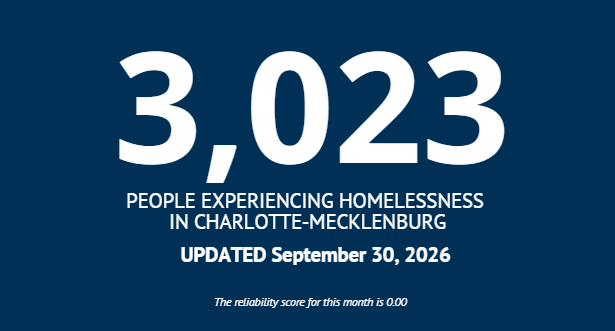
As of September 30, 2026, there are 3,023 individuals in 2,434 households experiencing homelessness in Charlotte-Mecklenburg. This total includes 2,027 single individuals, 126 unaccompanied youth, 237 households with minor children (totaling 796 people), and 45 families with multiple adults (totaling 92 people). Included in the total of 3,023 individuals, 165 are homeless Veterans, and 883 are individuals who are experiencing chronic homelessness. Based on these data, the minimum number of households experiencing homelessness right now (and therefore, the minimum number of housing units and/or subsidies needed) in Charlotte-Mecklenburg is 2,434.
Considering inflow (into homelessness) and outflow (out of homelessness), here are some noteworthy trends:
- Between August 2026 and September 2026, there was a 8% increase (or 213 people) increase in the total number of people experiencing homelessness. There has been a 29% (or 683 people) increase in overall homelessness since September 2025.
-
In September 2026, 579 individuals entered homelessness (inflow) and 366 people exited (outflow). Of the 579 individuals entering homelessness, 71% (410) were newly identified, 9% (50=) returned to homelessness from permanent housing, and 21% (119) returned from an inactive status. Of the 366 individuals exiting homelessness, 36% (133) moved to permanent housing and 64% (233) exited homelessness to an inactive status, which means that they had not been engaged in services for the previous 30 days.
- Between August 2026 and September 2026, overall homelessness increased for all populations. The number of people in families with children in homelessness increased by 7% (52 people), and the number of single adults increased by 8% (151 people). The number of veterans experiencing homelessness increased by 14% (20 people) and the number of people experiencing chronic homelessness increased by 8% (58 people). The number of people exiting to permanent housing compared to July 2026 was lower by 6% (9 people). However, the number of people in families with minor children exiting to permanent housing increased by 41% (23 people). The number of people experiencing chronic homelessness that exited to housing this month decreased by 34% (12 people). Finally, the median number of days it takes to exit homelessness into housing decreased by 68 days, from 264 to 196 days, but the average number of days increased, from 552 days to 662 days. The median tells us the typical number of days it takes to exit homelessness into housing while the average includes long-stayers in shelter and people experiencing chronic homelessness.
- According to the most recent One Number data, disaggregated by race and ethnicity, individuals who identify as Black/African American continue to experience homelessness at rates much higher than their proportion of the Mecklenburg County population (75% vs. 31%), while individuals who identify as White, non-Hispanic experience homelessness at a rate much lower than their population prevalence (15% vs. 43%). Individuals who identify as Hispanic/Latino only have a prevalence of 3% in the homeless population but comprise 18% of the Mecklenburg County population; this reflects a possible underrepresentation of the people who experience homelessness in Charlotte-Mecklenburg and identify as Hispanic/Latino.
So What
The September 2026 One Number data underscore a critical reality for Charlotte-Mecklenburg: homelessness is not only persisting, it continues to grow in ways that demand urgent, coordinated action. The continued imbalance between inflow and outflow, paired with increases across most household types, signals that the system is not yet keeping pace with demand.
At the same time, the data points to meaningful progress. Shorter lengths of time to housing demonstrate that targeted strategies can work when adequately supported. Perhaps most importantly, the persistent racial disparities highlight that homelessness in our community is deeply rooted in systemic inequities that need to be addressed alongside housing solutions.
The One Number is more than a metric–it is a call to action. It quantifies the scale of need today while signaling to the investments required to ensure that every household in Charlotte-Mecklenburg has access to safe, stable housing.