
Courtney Morton
Housing & Homelessness Research Coordinator
Mary Ann Priester
HMIS Administrator
Community Support Services partners with homeless service agencies in Charlotte-Mecklenburg to enter, collect, analyze and report data on housing and homelessness in the community. This June blog post describes the release of a new Housing Data Snapshot page, which provides regular reporting on three critical data points: the One Number, “By-Name” List Movement, and Coordinated Entry.
Starting with this blog post, as new data is added to the Housing Data Snapshot, we will highlight changes and provide in-depth analysis to describe what these changes mean for Charlotte-Mecklenburg.
CHRONIC HOMELESSNESS
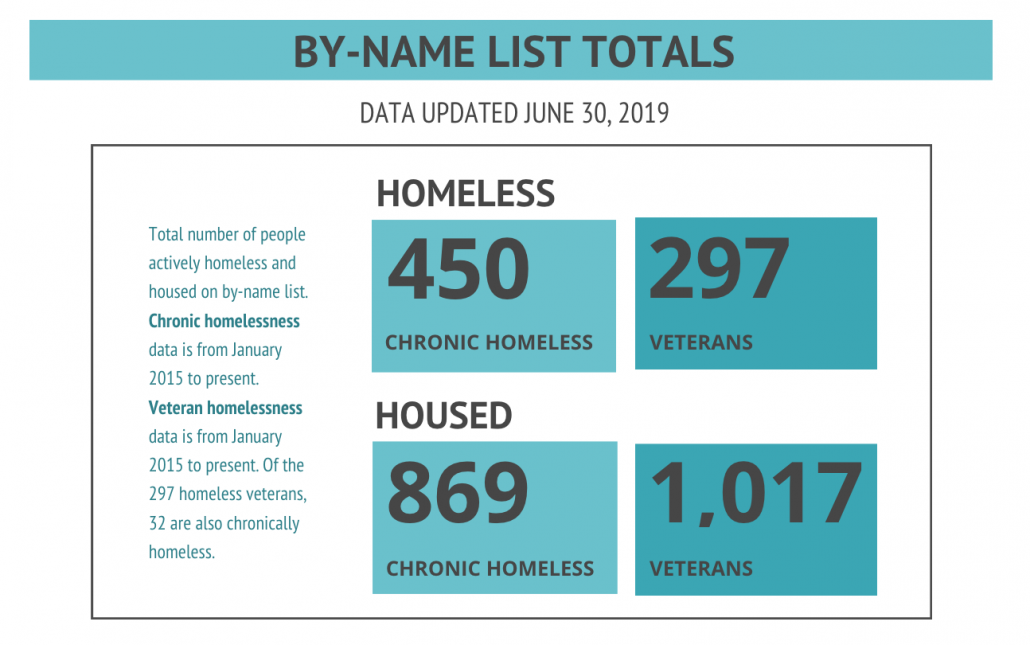
In June 2019, there are 450 chronically homeless individuals who are still homeless in Mecklenburg County. This number has continued to increase as inflow outpaces outflow. In June, the inflow was 26 compared with an outflow of 21, resulting in a net increase of 5 individuals homeless. Compared to the month prior, the number of chronically homeless individuals increased by 1%. During the past quarter, the average inflow is 30 individuals, whereas the average outflow is 24. Unless the outflow increases, (which requires new housing options) and/or inflow decreases (as a result of increased housing stability), the number of chronically homeless individuals will continue to increase.
VETERAN HOMELESSNESS
In June 2019, there are 297 veterans who are still homeless in Mecklenburg County. This number has continued to decrease as outflow outpaces inflow. In June, the inflow was 14 compared with an outflow of 16, resulting in a net decrease of 2 individuals homeless. Compared to the month prior, the number of homeless veterans decreased by 2%. During the past quarter, the average inflow is 15 individuals, whereas the average outflow is 24. To continue to decrease in veteran homelessness, housing resources must be targeted to reduce inflow and increase outflow.
COORDINATED ENTRY
The Housing Data Snapshot has been updated with data for the fourth quarter. The data includes the number of 2-1-1 calls for housing assistance, the number of households referred for an in-person Coordinated Assessment, and the number of households who received an in-person Coordinated Assessment. In addition, a table is provided via this link to Coordinated Entry data for FY19.
The average number of monthly 2-1-1 calls for FY19 is 617 and the average number of monthly in-person Coordinated Assessments is 327. It is important to note that while these numbers help illustrate the need for housing in the community, they do not provide a full picture of all the households who face housing instability and homelessness and who do not seek assistance through the homeless services system.
SO, WHAT
In order to effectively address housing instability and homelessness, we must more completely understand the problem. Data provides us with a tool to do this. The data helps us understand the need of and demand for housing assistance.
When used effectively, these data points can inform decision-making around housing and homelessness. Working groups dedicated to reducing inflow and increasing outflow among chronic and veteran homelessness meet regularly to brainstorm and test methods that can create positive change. It is critical that these groups continue to examine the inflow and outflow patterns in relationship to changes in programs and policies.
More housing is needed. At the end of June, the total number of actively homeless veterans and chronically homeless individuals was 747. In addition, the average inflow numbers into homelessness for both further illustrate a continued need for housing. The numbers are also an important tool to estimate annual housing need for planners and funders.
To download the newest Housing Data Snapshot as a PDF, click here.
Mary Ann Priester is the Homeless Management Information System (HMIS) Administrator for the Charlotte-Mecklenburg Continuum of Care (CoC). She provides data quality, security, and privacy oversight for the local HMIS system and technical support and training to 25+ agencies that serve individuals and families who are homeless or at risk of homelessness. Mary Ann also oversees data collection for the Point-in-Time Count.
Courtney Morton coordinates posts on the Building Bridges Blog. Courtney is the Housing & Homelessness Research Coordinator for Mecklenburg County Community Support Services. Courtney’s job is to connect data on housing instability, homelessness and affordable housing with stakeholders in the community so that they can use it to drive policy-making, funding allocation and programmatic change.