
Mary Ann Priester, PhD, MSW
Senior Management Analyst
Mecklenburg County Community Support Services
Since its inception in 2019 , the “One Number” has served as the primary benchmark for the number of people experiencing homelessness in Charlotte-Mecklenburg.
The One Number is the best snapshot available for the number of people actively experiencing homelessness in Charlotte-Mecklenburg. It provides the most accurate minimum number of people experiencing homeless and provides insights into the minimum number of housing units and subsidies needed today to address their homelessness. These data also provide timely insights into the number of people flowing into and out of the homeless services system.
The Housing Data Snapshot, the hub for the latest data related to housing and homelessness in Charlotte-Mecklenburg, not only provides an overall count and demographics of homelessness by household type and subpopulation, it also highlights inflow to (Newly identified, Returns from Permanent Housing, Returns for Inactivity) and outflow from (Exit to Permanent Housing, Exit to Inactivity), homelessness.
This week’s blog post provides the most recent One Number update; a synopsis of recent dashboard updates; the latest One Number trends and analysis; and what this means for Charlotte-Mecklenburg.
LATEST DATA & TRENDS
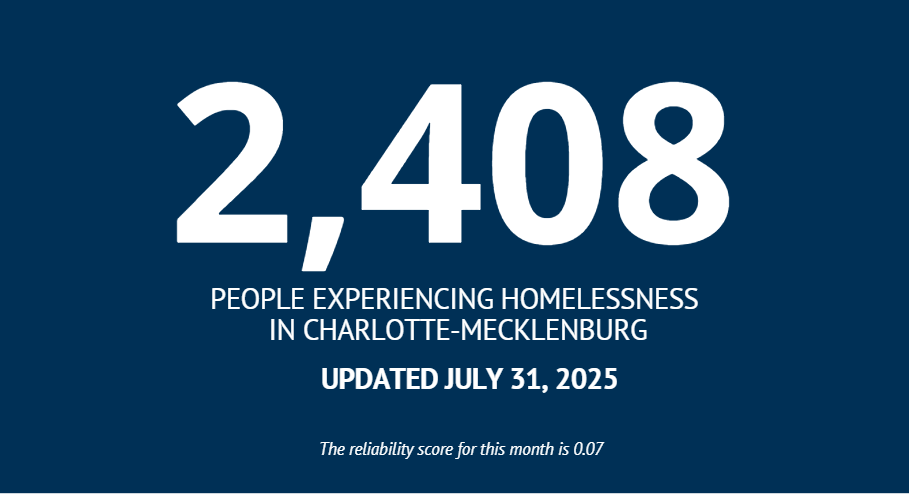
As of July 31, 2025, there are 2,408 individuals experiencing homelessness in Charlotte-Mecklenburg. This total includes 1,596 single individuals, 163 unaccompanied youth, 191 households with minor children (totaling 602 people), and 29 families with multiple adults (totaling 56 people). Included in the total of 2,408 individuals, 143 are homeless Veterans, and 712 are individuals who are experiencing chronic homelessness. Based on these data, the minimum number of people experiencing homelessness right now (and therefore, the minimum number of housing units and/or subsidies needed) in Charlotte-Mecklenburg is 2,408.
Considering inflow (into homelessness) and outflow (out of homelessness), here are some noteworthy trends:
- Between June 2025 and July 2025, there was a 4 person increase in the total number of people experiencing homelessness. There has been a 22% (or 676 person) decrease in overall homelessness since July 2024.
- In July 2025, 693 individuals entered homelessness (inflow) and 521 people exited (outflow). Of the 693 individuals entering homelessness, 65% (451) were newly identified, 9% (64) returned to homelessness from permanent housing and 26% (178) returned from an inactive status. Of the 521 individuals exiting homelessness, 32% (164) moved to permanent housing and 68 % (358) exited homelessness to an inactive status, which means that they had not been engaged in services for the previous 30 days.
- Between June 2025 and July 2025, overall homelessness decreased as did homelessness for single adult households, multiple adult households, veteran homelessness, and chronic homelessness. Homelessness among unaccompanied youth stayed flat. Homelessness among households with minor children increased. Finally, the median number of days it takes to exit homelessness into housing decreased 251 days from 436 days to 185 days and the average number of days it takes to exit homelessness into housing decreased from 748 days to 509 days. The median tells us the typical number of days it takes to exit homelessness into housing while the average includes long-stayers in shelter and people experiencing chronic homelessness.
- According to the most recent One Number data, disaggregated by race and ethnicity, individuals who identify as Black/African American continue to experience homelessness at rates much higher than their proportion of the Mecklenburg County population (74% vs. 33%) while individuals who identify as White, non-Hispanic experience homelessness at a rate much lower than their prevalence in the population (16% vs 45%). Individuals who identify as Hispanic/Latino only have a prevalence of 3% in the homeless population but comprise 14% of the Mecklenburg County population; this reflects a possible underrepresentation of the people who experience homelessness in Charlotte-Mecklenburg and identify as Hispanic/Latino.
SO, WHAT
This month’s One Number reminds us that while Mecklenburg County is making progress on its goal to end homelessness, it still has work to do. There are fewer people are experiencing homelessness in Mecklenburg County compared to last year, and the length of time it takes for people to exit homelessness is decreasing. Conversely, the increase in the number of families with minor children and the ongoing and persistent racial disparities among people experiencing homelessness highlights the continued need for dedicated resources to ensure everyone has access to housing. For our community, these data are not just numbers, they represent individuals, families, and stories. Charlotte-Mecklenburg has both an opportunity and a responsibility to continue developing and implementing innovative, equitable, person-centered, data-driven solutions that ensure homelessness is rare, brief, and non-recurring.