
Mary Ann Priester, PhD, MSW
Senior Management Analyst
Mecklenburg County Community Support Services
Since its inception in 2019 , the “One Number” has served as the primary benchmark for the number of people experiencing homelessness in Charlotte-Mecklenburg.It provides the best available snapshot of people actively experiencing homelessness and offers critical insight into the minimum number of housing units and subsidies needed today to address that need. The One Number also tracks how people flow into and out of the homeless services system over time.
This week’s blog provides the most recent One Number update, key trends and analysis, and what the latest data mean for Charlotte-Mecklenburg.
LATEST DATA & TRENDS
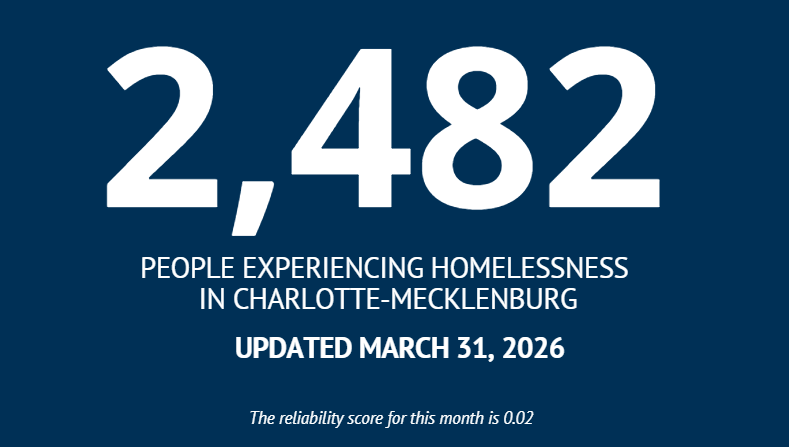
As of March 31, 2026, there are 2,482 individuals in 2,070 households experiencing homelessness in Charlotte-Mecklenburg. This total includes 1,724 single individuals, 144 unaccompanied youth, 161 households with minor children (totaling 555 people), and 39 families with multiple adults (totaling 70 people). Included in the total of 2,482 individuals, 157 are homeless Veterans, and 744 are individuals who are experiencing chronic homelessness. Based on these data, the minimum number of households experiencing homelessness right now (and therefore, the minimum number of housing units and/or subsidies needed) in Charlotte-Mecklenburg is 2,070.
Considering inflow (into homelessness) and outflow (out of homelessness), here are some noteworthy trends:
- Between February 2026 and March 2026, there was a 240 person decrease in the total number of people experiencing homelessness. There has been a 5% (or 118 person) decrease in overall homelessness since March 2025.
- In March 2026, 587 individuals entered homelessness (inflow) and 656 people exited (outflow). Of the 587 individuals entering homelessness, 65% (384) were newly identified, 6% (38) returned to homelessness from permanent housing, and 28% (166) returned from an inactive status. Of the 656 individuals exiting homelessness, 23% (153) moved to permanent housing and 77% (503) exited homelessness to an inactive status, which means that they had not been engaged in services for the previous 30 days.
- In March 2026, 587 individuals entered homelessness (inflow) and 656 people exited (outflow). Of the 587 individuals entering homelessness, 65% (384) were newly identified, 6% (38) returned to homelessness from permanent housing, and 28% (166) returned from an inactive status. Of the 656 individuals exiting homelessness, 23% (153) moved to permanent housing and 77% (503) exited homelessness to an inactive status, which means that they had not been engaged in services for the previous 30 days.
- According to the most recent One Number data, disaggregated by race and ethnicity, individuals who identify as Black/African American continue to experience homelessness at rates much higher than their proportion of the Mecklenburg County population (74% vs. 33%) while individuals who identify as White, non-Hispanic experience homelessness at a rate much lower than their prevalence in the population (15% vs 45%). Individuals who identify as Hispanic/Latino only have a prevalence of 3% in the homeless population but comprise 14% of the Mecklenburg County population; this reflects a possible underrepresentation of the people who experience homelessness in Charlotte-Mecklenburg and identify as Hispanic/Latino.
SO, WHAT
At first glance, this month’s decrease in overall homelessness may appear to signal meaningful progress, but the data tell a more nuanced story. Much of the decline is likely the result of intentional data cleanup efforts tied to the 2026 Point-in-Time Count submission, rather than a true reduction in the number of people experiencing homelessness. The large number of exits to inactive status, alongside relatively stable inflow, suggests that many individuals were removed from the system due to disengagement rather than being connected to permanent housing. While improvements in time to housing are encouraging, they should be interpreted with caution given the impact of these data adjustments. This moment underscores the importance of understanding not just what the numbers are, but how they are generated. The One Number remains a critical tool for assessing need, but it also requires careful interpretation to ensure we do not overstate progress or underestimate the level of housing resources required. Ultimately, the need for safe, stable, and affordable housing in Charlotte-Mecklenburg remains substantial, and continued, coordinated investment is necessary to meet that need.