
Mary Ann Priester, PhD, MSW
Senior Management Analyst
Mecklenburg County Community Support Services
Since its inception in 2019 , the One Number has served as the primary benchmark for the number of people experiencing homelessness in Charlotte-Mecklenburg. It provides the best available snapshot of people actively experiencing homelessness and offers critical insight into the minimum number of housing units and subsidies needed today to address that need. The One Number also tracks how people flow into and out of the homeless services system over time.
This week’s blog provides the most recent One Number update, key trends and analysis, and what the latest data mean for Charlotte-Mecklenburg.
LATEST DATA & TRENDS
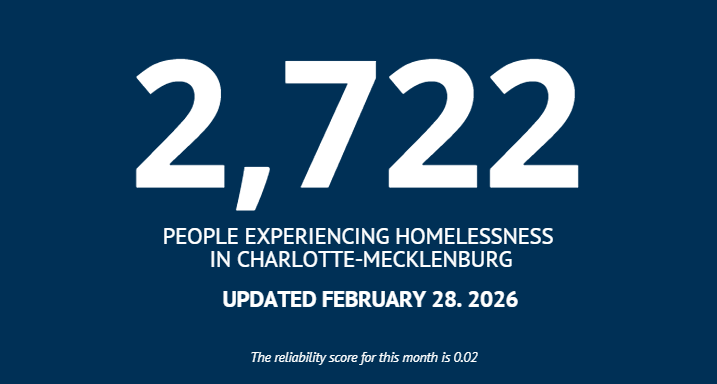
As of February 28, 2026, there are 2,722 individuals in 2,253 households experiencing homelessness in Charlotte-Mecklenburg. This total includes 1,843 single individuals, 157 unaccompanied youth, 213 households with minor children (totaling 671 people), and 42 families with multiple adults (totaling 69 people). Included in the total of 2,722 individuals, 157 are homeless Veterans, and 760 are individuals who are experiencing chronic homelessness. Based on these data, the minimum number of households experiencing homelessness right now (and therefore, the minimum number of housing units and/or subsidies needed) in Charlotte-Mecklenburg is 2,253.
Considering inflow (into homelessness) and outflow (out of homelessness), here are some noteworthy trends:
- Between January 2026 and February 2026, there was a 44 person increase in the total number of people experiencing homelessness. There has been a 2% (or 52 person) increase in overall homelessness since February 2025.
- In February 2026, 584 individuals entered homelessness (inflow) and 498 people exited (outflow). Of the 584 individuals entering homelessness, 65% (381) were newly identified, 11% (60) returned to homelessness from permanent housing, and 25% (143) returned from an inactive status. Of the 498 individuals exiting homelessness, 21% (105) moved to permanent housing and 79% (393) exited homelessness to an inactive status, which means that they had not been engaged in services for the previous 30 days.
- Between January 2026 and February 2026, overall homelessness increased for all populations except unaccompanied youth which remained flat. There was a 3% increase among single adults (45 people). Among households with minor children, there was a 8% increase in the number of households (15 households) and among multiple adult households there was an 8% increase (3 households). Among veterans, there was a 2% increase (6 people) and a 4% increase among persons that meet the criteria for chronic homelessness (28 people).Finally, the median number of days it takes to exit homelessness into housing decreased by 35 days, from 254 to 219 days, and the average number of days decreased from 520 to 463 days. The median tells us the typical number of days it takes to exit homelessness into housing while the average includes long-stayers in shelter and people experiencing chronic homelessness.
- According to the most recent One Number data, disaggregated by race and ethnicity, individuals who identify as Black/African American continue to experience homelessness at rates much higher than their proportion of the Mecklenburg County population (75% vs. 33%) while individuals who identify as White, non-Hispanic experience homelessness at a rate much lower than their prevalence in the population (14% vs 45%). Individuals who identify as Hispanic/Latino only have a prevalence of 3% in the homeless population but comprise 14% of the Mecklenburg County population; this reflects a possible underrepresentation of the people who experience homelessness in Charlotte-Mecklenburg and identify as Hispanic/Latino.
SO, WHAT
Ultimately, the February 2026 One Number data underscore a critical reality for Charlotte-Mecklenburg: homelessness is not only persisting, it is growing in ways that require urgent, coordinated action. The continued imbalance between inflow and outflow, combined with increases across nearly all household types, signals that the system is not yet keeping pace with demand. At the same time, the data reveal meaningful progress, including shorter lengths of time to housing, which show that targeted strategies can and do work when adequately resourced. Perhaps most importantly, the persistent racial disparities highlight that homelessness in our community is deeply intertwined with structural inequities that must be addressed alongside housing solutions. The One Number is more than a metric, it is a call to action. It quantifies the scale of need today while pointing directly to the investments required to ensure that every household in Charlotte-Mecklenburg has access to safe, stable housing.